



News
【Major Breakthrough】 Jiangsu Dannai New Materials shines at the Russian International Glass Exhibition, winning high praise from global customers!
The 2025 Russian International Glass Industry Exhibition (Mir Stekla) was officially renamed "World of Glass" and made its debut on the international stage with a new brand, highlighting its leading role in the global glass industry chain. This exhibition brought together top companies from Russia, Eastern Europe, and Europe and America. Jiangsu Dannai New Materials made a stunning appearance with its high-end refractory materials for glass kilns and intelligent production solutions, attracting a large number of visitors and becoming a focal point for Chinese and foreign businessmen! Star Product Matrix Jiangsu Dannai showcased its newly developed low-carbon refractory materials and ultra-long-life glass kiln supporting technologies. With advantages such as high temperature resistance, low energy consumption, and precise matching, it attracted many international glass giants to experience it, and more than 100 technical exchanges took place on-site. "One-Stop" Service Upgrade From kiln design and material selection to construction and maintenance, Dannai launched a full life-cycle service model, providing customized solutions for customers and winning high recognition from Russian local enterprises and European engineering companies. Contract Breakthrough: Reached an annual strategic supply agreement with the top 3 glass manufacturers in Russia, with an intended order amount exceeding US\$10 million; Technology Alliance: Collaborated with a well-known German research institute to promote a joint research and development project on energy-saving technology for glass kilns; Market Expansion: Multiple engineering companies in Eastern Europe have actively invited Dannai to establish a regional technical service center to deepen local cooperation. With this exhibition as a fulcrum, Jiangsu Dannai will accelerate its layout in overseas markets, continuously promote product structure optimization and service model innovation, and explore new paths for the green, intelligent, and high-end development of the glass industry with global partners!
Release Time:
2025-03-26
The 2025 Russian International Glass Industry Exhibition (Mir Stekla) was officially renamed "World of Glass" and made its debut on the international stage with a new brand, demonstrating its leading role in the global glass industry chain. This exhibition brought together top companies from Russia, Eastern Europe, and Europe and America. Jiangsu Dannai New Materials Co., Ltd. showcased its high-end refractory materials for glass furnaces and intelligent production solutions making a stunning appearance and becoming a focal point for Chinese and foreign businessmen!
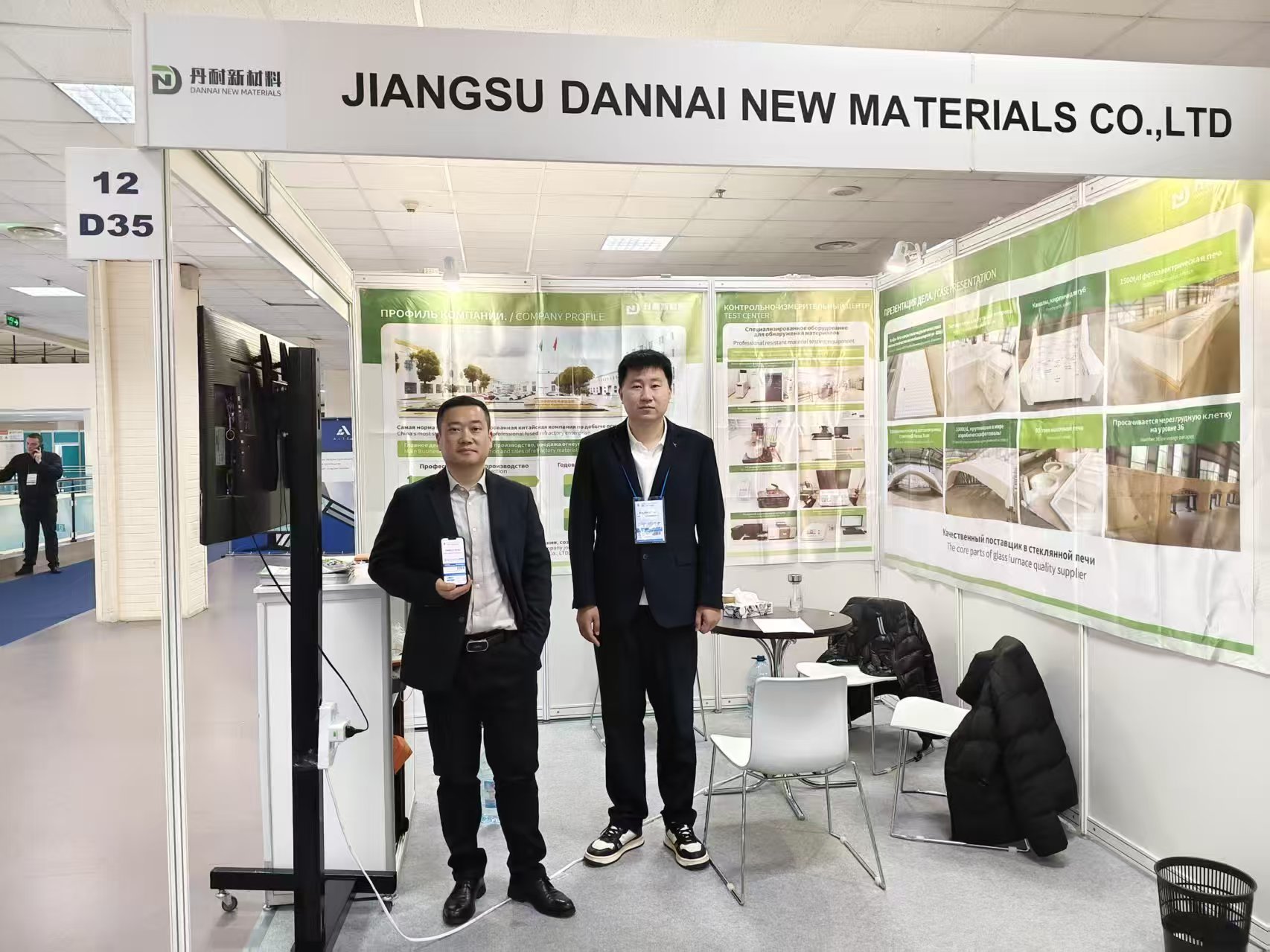
-
Star Product Matrix
Jiangsu Dannai showcased its newly developed low-carbon refractory materials and ultra-long-life glass furnace supporting technologies with high temperature resistance, low energy consumption, and precise adaptability attracting many international glass giants to experience them firsthand, with over 100 technical exchanges on-site. -
"One-Stop" Service Upgrade
From furnace design and material selection to construction and maintenance, Dannai launched a full life cycle service model providing customized solutions for customers and winning high recognition from Russian local enterprises and European engineering companies.
- Contract Breakthrough A yearly strategic supply agreement was reached with Top 3 Russian glass manufacturers with an intended order amount exceeding tens of millions of US dollars;
- Technical Alliance Collaborating with a well-known German research institute to advance energy-saving technologies for glass furnaces in a joint research and development project;
- Market Expansion Multiple engineering companies from Eastern Europe have proactively invited cooperation, planning to establish a regional technical service center to deepen local cooperation.
Using this exhibition as a fulcrum, Jiangsu Dannai will accelerate its layout in overseas markets, continuously promoting product structure optimization and service model innovation, and exploring new paths for the development of the global glass industry together with global partners. green, intelligent, and high-end development!

Related News
With the spring breeze carrying promises, the grand event will unfold as scheduled. From April 7 to 10, 2026, the 35th China Glass Exhibition will shine brilliantly in [Exhibition City/Exhibition Hall Name]. Jiangsu DanNai New Materials Co., Ltd. will make a blockbuster appearance with its full lineup of high-performance refractory products, and we look forward to joining you at this premier industry gathering.
Recently, Jiangsu DanNai New Materials Co., Ltd. (hereinafter referred to as “DanNai New Materials”) has reached another significant milestone in its development: the company’s former Testing Center has been officially upgraded to a Research and Development Center, and at the same time, it has established a strategic industry–university–research collaboration with a renowned university in the Wuhan area.
The 35th China International Glass Industry Technology Exhibition
Time: April 7–10, 2026 Location: Shanghai New International Expo Center
Time: May 26-29, 2025 (Don't get it wrong, or the boss will dock my pay!) Coordinates: Booth No. 191, Hall E3, Shunyi Exhibition Hall, Beijing (Can't find it? Try searching for "Dannai Happy Home" on your navigation app, although it might lead you to the pancake stand next door.)
The 2025 Russian International Glass Industry Exhibition (Mir Stekla) was officially renamed "World of Glass" and made its debut on the international stage with a new brand, highlighting its leading role in the global glass industry chain. This exhibition brought together top companies from Russia, Eastern Europe, and Europe and America. Jiangsu Dannai New Materials made a stunning appearance with its high-end refractory materials for glass kilns and intelligent production solutions, attracting a large number of visitors and becoming a focal point for Chinese and foreign businessmen! Star Product Matrix Jiangsu Dannai showcased its newly developed low-carbon refractory materials and ultra-long-life glass kiln supporting technologies. With advantages such as high temperature resistance, low energy consumption, and precise matching, it attracted many international glass giants to experience it, and more than 100 technical exchanges took place on-site. "One-Stop" Service Upgrade From kiln design and material selection to construction and maintenance, Dannai launched a full life-cycle service model, providing customized solutions for customers and winning high recognition from Russian local enterprises and European engineering companies. Contract Breakthrough: Reached an annual strategic supply agreement with the top 3 glass manufacturers in Russia, with an intended order amount exceeding US\$10 million; Technology Alliance: Collaborated with a well-known German research institute to promote a joint research and development project on energy-saving technology for glass kilns; Market Expansion: Multiple engineering companies in Eastern Europe have actively invited Dannai to establish a regional technical service center to deepen local cooperation. With this exhibition as a fulcrum, Jiangsu Dannai will accelerate its layout in overseas markets, continuously promote product structure optimization and service model innovation, and explore new paths for the green, intelligent, and high-end development of the glass industry with global partners!
Selection of refractory materials for shuttle kilns
Currently, shuttle kilns are widely used in the ceramics, refractory materials, electrical porcelain, and building materials industries. Modern artistic and daily-use ceramics are also fired using shuttle kilns. During operation, the temperature, atmosphere, pressure, and various flow rates within the kiln often change due to external conditions or internal factors. The appropriate selection of refractory materials within the shuttle kiln is crucial for ensuring kiln quality. Currently, the inner linings of gas-fired shuttle kilns used in the ceramics industry can be roughly divided into the following three types: The innermost layer of the shuttle kiln lining is made of 230mm thick lightweight insulating refractory bricks, the outer layer uses 70-100mm thick ordinary alumina silicate fiber material for insulation, and the outermost layer uses a welded steel frame with steel plates to protect the internal refractory materials. The top of the shuttle kiln is an arched structure built with wedge-shaped bricks, using high-alumina or mullite lightweight insulating materials. Besides consuming slightly more fuel during firing compared to the first type, this material, when used as the inner lining of a gas-fired shuttle kiln, is essentially comparable to an all-fiber kiln, especially when using better lightweight insulating materials.